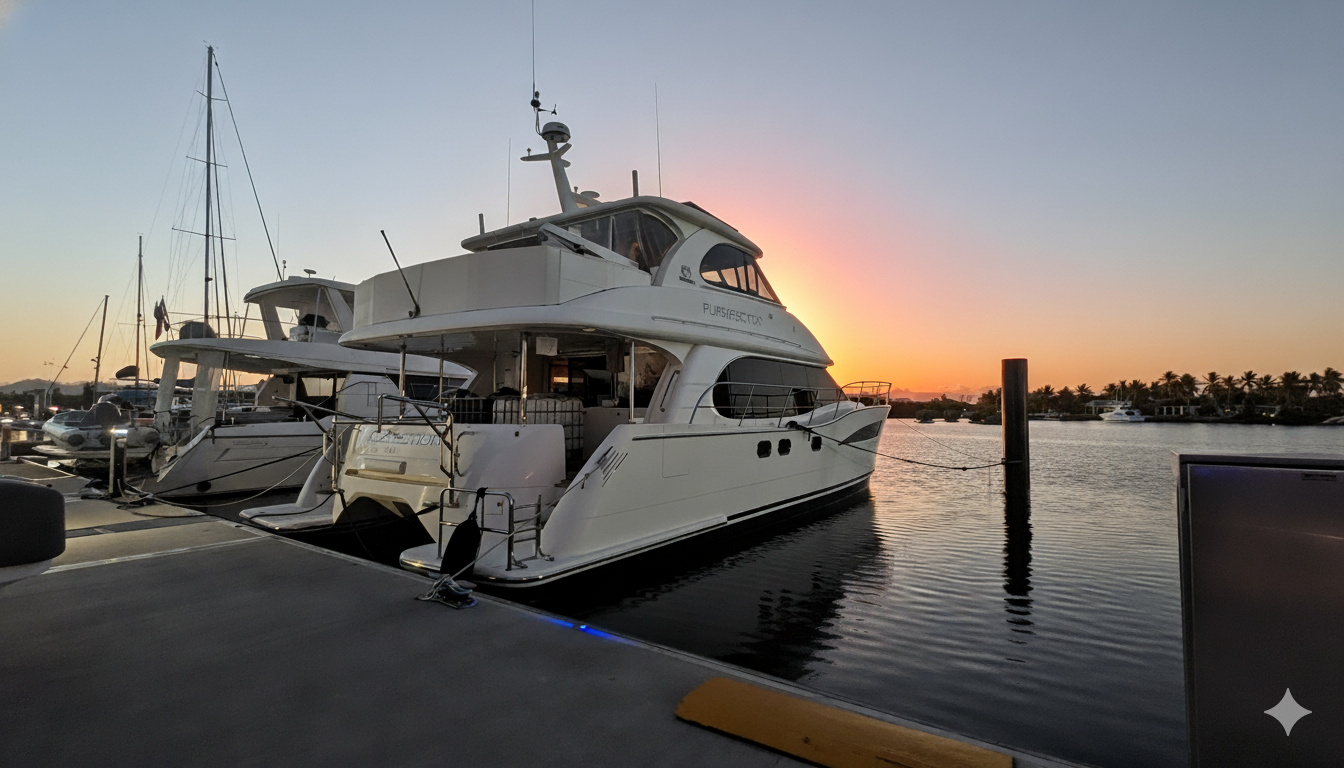
This Horizon PC52 has now been delivered by us four separate times through Pacific islands and to Australia over the past three years.
Operating a Horizon PC52 Across the Coral Sea
This Horizon PC52 delivery from Fiji to Brisbane was notable less because of the route itself and more because of the operational familiarity involved. Over the last three years we have delivered this particular vessel four separate times between Australia and the South Pacific, which changes the nature of the preparation considerably compared to a first-time handover or unknown vessel.
The Horizon PC52 is a capable long-range power catamaran for this type of work. The combination of efficient cruising speeds, relatively low fuel burn for the volume carried, and good internal systems access makes it practical for repeated offshore relocation work across the Coral Sea and western South Pacific.
Preparing a Power Catamaran for Coral Sea Work
Although the Horizon PC52 has substantial fuel capacity compared to many coastal motor yachts, Fiji to QLD is still a serious offshore leg requiring proper range calculations and conservative planning margins.
Because we had delivered this particular Horizon PC52 multiple times previously, there was already a strong understanding of normal engine temperatures, fuel transfer behaviour, cruising sweet spots, and system quirks onboard. That familiarity matters offshore. It allows issues to be identified early because the crew already knows what “normal” looks like on that vessel.
Fiji Departure and South Pacific Routing
Departures from Fiji toward Australia require balancing weather considerations rather than simply waiting for “good weather”.
Trade wind strength through the Fiji basin, Coral Sea trough development, Tasman Sea movement, and East Australian Current interaction all influence routing decisions. Conditions that appear manageable departing Fiji can deteriorate rapidly approaching the Australian coast.
The initial section out of Fiji involved typical South Pacific trade wind conditions with moderate easterly swell and relatively stable overnight running. Commercial traffic remained minimal for much of the offshore section until approaching the Australian coast and shipping lanes feeding Brisbane.
The Coral Sea often develops confused sea states during transitional weather periods, particularly when residual swell systems intersect newer southeast wind waves. The PC52 handled these conditions well overall, although—as with many power catamarans—there is always a balance between speed, bridge deck motion, and fuel economy.
Repeated operation of the vessel allowed for fairly precise speed management based on sea state. There is little value forcing a powerboat through uncomfortable conditions simply to maintain schedule if fuel burn rises.
Watchkeeping and Offshore Systems Management
Long-range motor yacht deliveries involve a different onboard routine compared to sailing deliveries.
Engine room monitoring becomes a central part of the watch system rather than a periodic task. Temperatures, fuel transfer, hydraulic systems, charging loads, and generator operation all require continuous oversight during offshore passages.
One operational advantage of the Horizon PC52 layout is relatively good engine room accessibility compared to some similarly sized motor yachts. That becomes important offshore when systems inspections are happening repeatedly every day in moving conditions.
Australian Coast Approach and Brisbane Arrival
The final approach toward the Australian coast is often the most operationally demanding section of a Fiji to Brisbane yacht delivery.
For this delivery the approach into Queensland remained relatively manageable, allowing a direct run toward Brisbane without extended holding offshore.
River approaches into Brisbane also require attention to tidal timing, commercial traffic coordination, and biosecurity procedures following international arrivals.
After multiple deliveries on this same Horizon PC52, arrival procedures had become relatively streamlined operationally, although Australian clearance requirements and vessel preparation standards remain strict compared to many Pacific jurisdictions.
The vessel arrived in Brisbane without major mechanical issues and was prepared for owner handover shortly afterwards.