
A motor yacht delivery of a Nordhavn 76 from Cairns to Singapore is a serious international passage across multiple climatic zones and regulatory environments. It is not a coastal repositioning. It is a long-range motor yacht operation requiring fuel discipline, mechanical oversight, and conservative weather sequencing through northern Australia and Southeast Asia.
For a vessel of this scale and value, the objective is straightforward: move a high-value offshore asset safely, efficiently, and without unnecessary system stress.
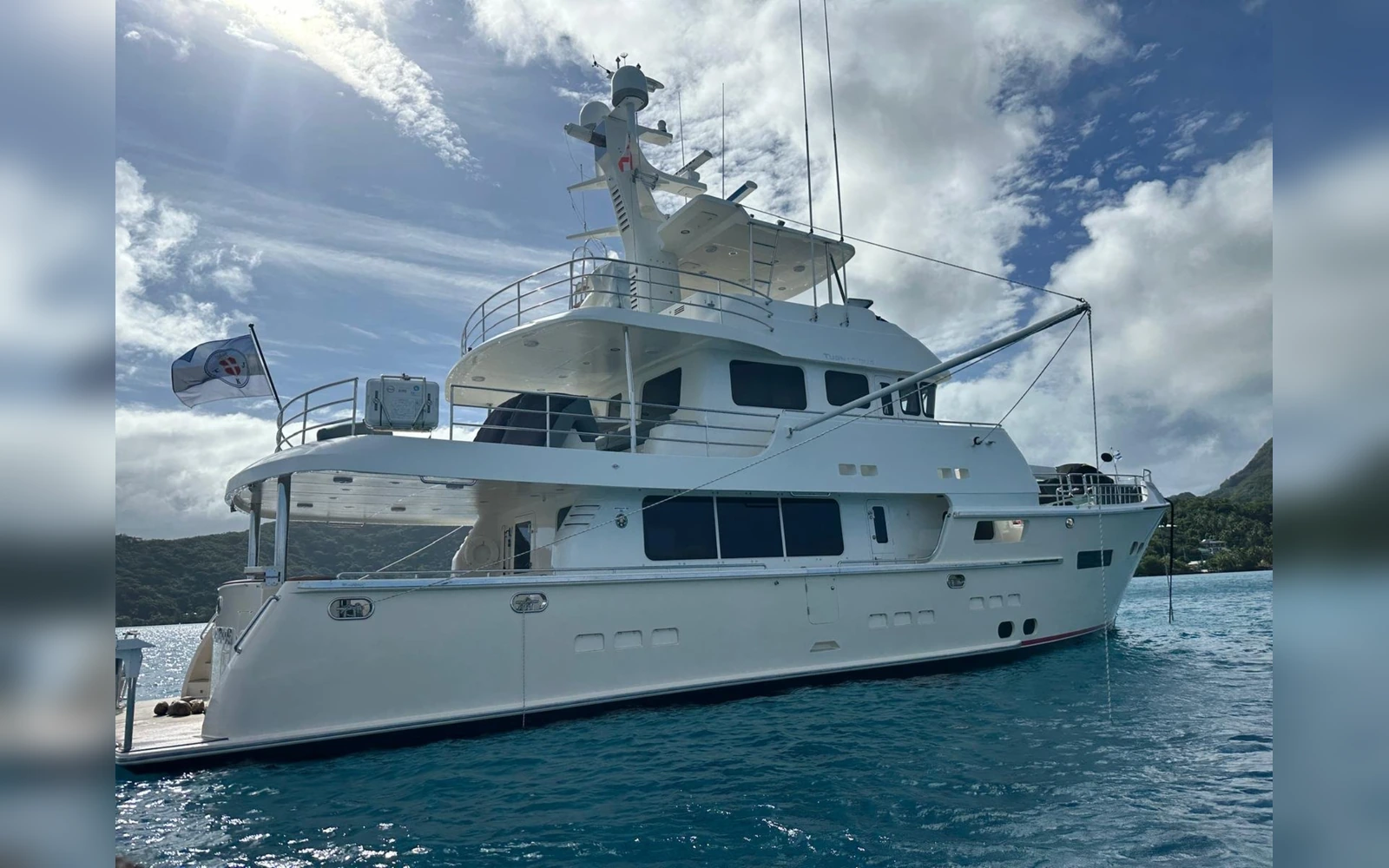
The Nordhavn 76 is designed as a true passagemaker. Full displacement hull form, deep forefoot, protected running gear, commercial-grade systems architecture, and substantial tankage place it firmly in the long-range category.
However, size and build quality do not remove delivery risk. A 76-foot displacement yacht carries:
Large fuel volumes across multiple tanks
Complex fuel transfer systems
Twin generators and heavy electrical loads
Stabiliser systems under sustained operation
Redundant but interlinked mechanical systems
On a multi-thousand-mile run from Cairns to Singapore, systems will operate continuously in tropical water. Cooling efficiency, filtration, hydraulic integrity, and electrical stability become central to the voyage.
The Nordhavn platform is capable. The delivery success depends on preparation depth.
The route typically progresses in structured stages:
Cairns to Torres Strait
Torres Strait transit
Arafura Sea / Northern Australia
Timor Sea or Indonesian archipelago routing
Malacca Strait approach
Singapore arrival
Each stage introduces different risk variables—navigational compression, tidal flow, commercial traffic, or weather instability.
Departure from Cairns requires alignment with tidal flow and reef clearance. The Great Barrier Reef section demands precise navigation and redundancy in charting systems.
Engine and cooling systems must be monitored closely in warm water conditions. Debris and biological load in northern waters can affect raw-water intakes. Strainer checks become part of routine watch procedures.
Fuel burn calculations at this stage are validated against real sea-state performance, not theoretical efficiency.
Torres Strait remains one of the most technically demanding navigational choke points in the region.
Strong tidal streams, shallow areas, and shipping traffic require structured transit planning. For a 76-foot displacement yacht, maneuverability is sufficient—but only if propulsion systems are operating flawlessly.
There is little tolerance for fuel contamination or overheating in this zone. Engine room checks are conducted frequently and logged.
Once clear of the Strait, the vessel transitions into longer offshore legs.
Here, the focus shifts to:
Fuel management and transfer sequencing
Generator load balancing
Stabiliser system monitoring
Crew fatigue management
The Nordhavn 76 is comfortable at moderate displacement speeds, typically in the 8–9 knot range. Pushing above that for schedule reasons increases fuel burn exponentially and reduces range margins.
Conservative speed selection preserves systems and extends operational resilience.
From northern Australia, routing options vary based on season and conditions.
During stable periods, some operators route through Indonesian waters, utilising sheltered passages but navigating:
Traffic density
Fishing activity
Variable chart accuracy
Regulatory clearance requirements
Alternatively, more open-water routing reduces navigational complexity but increases exposure to sea state and weather variability.
Professional delivery decisions are based on forecast stability, political and customs considerations, and the vessel’s fuel and crew profile—not convenience.
On a Nordhavn 76 delivery, engine room management is continuous.
Key priorities include:
Monitoring fuel transfer systems for contamination or imbalance
Inspecting hydraulic stabiliser systems under load
Verifying generator redundancy
Managing cooling systems in tropical temperatures
High ambient water temperatures reduce cooling efficiency. Impellers, heat exchangers, and raw-water strainers are monitored closely.
The scale of the vessel means minor mechanical anomalies can escalate if not addressed early. Proactive inspection prevents escalation.
Approaching Singapore introduces one of the busiest commercial shipping corridors in the world: the Malacca Strait.
Traffic density increases dramatically. Watch systems tighten. Radar, AIS, and visual navigation operate in parallel.
Fatigue management becomes critical at this stage. After extended offshore running, the final approach demands heightened concentration and structured watch discipline.
Singapore arrival is not complex technically, but it is operationally dense.
A defining feature of the Nordhavn 76 is its fuel capacity. However, capacity alone does not equal effective range.
Professional delivery includes:
Conservative fuel burn modelling
Verification of tank soundings
Documented fuel transfer logs
Reserve margins preserved until final approach
Overconfidence in tankage is a common failure mode in long-range motor yacht deliveries. Real-world burn rates vary with sea state, stabiliser use, and generator load.
Range discipline is maintained throughout the passage.
On a passage of this scale, continuous communication is expected.
Modern offshore delivery uses satellite connectivity and real-time tracking to provide:
Position updates
Weather commentary
Systems reporting
Fuel status transparency
Owners and brokers are kept informed throughout. This is not optional on a yacht of this value.
Arrival into Singapore requires compliance with port control procedures and coordinated marina entry.
Final delivery protocol includes:
Engine and system inspection
Fuel reconciliation
Passage log and systems summary
Preparation for handover or brokerage presentation
Singapore is a major Southeast Asian hub. Professional presentation at completion supports asset value and buyer confidence.
A Nordhavn 76 from Cairns to Singapore represents:
Significant asset value
Extended exposure to tropical mechanical stress
Complex routing environments
High-traffic arrival corridors
The risks are manageable—but only with disciplined preparation and structured oversight.
Professional delivery removes schedule pressure and introduces:
Conservative weather sequencing
Continuous mechanical supervision
Documented fuel and systems management
Structured crew fatigue control
For displacement yachts of this scale, the voyage is an operational project—not a casual repositioning.
The Cairns to Singapore route is well within the capability of a Nordhavn 76. However, capability must be supported by preparation.
When approached methodically, the passage is predictable. When rushed or under-supervised, system strain accumulates and risk increases.
On long-range motor yachts, success offshore is rarely dramatic. It is quiet, structured, and controlled from departure to arrival.

Get My Delivery Info