
A Tasman Sea crossing from Queensland to New Zealand is not a casual offshore passage. It is a serious ocean delivery that exposes weaknesses in boats, crew, and planning very quickly. While yachts make the crossing successfully, most problems encountered offshore can be traced back to inadequate preparation, not bad luck.
This article sets out what actually matters when preparing to cross the Tasman from Australia to New Zealand, based on delivery realities rather than cruising optimism.
The Tasman Sea sits between two high-latitude weather systems and is dominated by fast-moving lows, strong frontal activity, and large, confused seas. 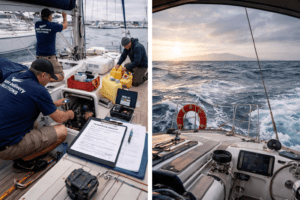 Unlike trade-wind routes, conditions are rarely stable for long.
Key characteristics of the Tasman:
Rapidly changing weather
Steep sea states, especially in opposing wind/current
Limited bailout options once committed
High fatigue load on crew and systems
This is why insurers, brokers, and experienced delivery skippers treat the Tasman as a threshold passage. Boats and crews that are marginal are exposed quickly.
The Tasman will find movement. Anything that works loose offshore will do so repeatedly.
Before departure:
Inspect chainplates, deck fittings, pulpits, stanchions, and lifelines
Remove unnecessary deck gear and secure everything else
Eliminate water ingress paths—hatches, ports, cockpit lockers
Cosmetic issues are irrelevant. Structural ones are not.
Rig failure is one of the most common delivery-ending events.
Minimum expectations:
Standing rigging with known age and condition
No unresolved cracks, corrosion, or movement at terminals
Running rigging sized appropriately and not marginal
At least one genuinely heavy-weather sail option
A sail inventory designed only for coastal cruising is not adequate.
Engines are not backups on a Tasman crossing—they are primary safety systems.
Preparation should include:
Full engine service immediately prior to departure
Fuel system inspection (hoses, filters, tanks)
Spare filters, belts, impellers, fluids
Confidence the engine can run continuously if required
For power vessels, range calculations must assume head seas and reduced efficiency, not brochure numbers.
Autopilot failures are routine offshore. Steering failures are not rare.
At minimum:
Autopilot recently serviced and tested under load
Backup control options understood and usable
Emergency steering prepared and rehearsed
Crew fatigue skyrockets when steering systems are marginal.
Tasman crossings are long enough that single-point failures matter.
Critical systems:
Navigation (chartplotter + backup)
Communications (VHF + offshore comms)
Autopilot power supply
Battery charging and monitoring
Assume at least one system will fail. Plan accordingly.
New Zealand authorities and insurers expect offshore-standard safety equipment, regardless of flag state.
Core expectations include:
Liferaft in service
EPIRB and PLBs
Jacklines, tethers, and harnesses
Offshore first aid capability
Storm tactics appropriate to vessel type
Equipment that is “technically present” but untested is not adequate.
A Tasman crossing is not the place for a crew entirely new to offshore sailing.
At least one additional crew member beyond the skipper should have:
Night watch experience
Heavy-weather exposure
Basic mechanical competence
Personality matters offshore. Fatigue amplifies poor dynamics.
Expect disrupted sleep for extended periods.
Professional deliveries typically use:
Short, disciplined watch rotations
Clear rules around rest and decision-making
Conservative fatigue management
Poor watch systems lead directly to bad decisions.
Tasman crossings are frequently delayed mid-passage by weather or speed reduction.
Provisioning should assume:
Extra days at sea
Limited cooking ability in rough conditions
High caloric demand
Hydration redundancy
Running low on food or water offshore is not a planning error—it is a systems failure.
There is no fixed “best date” to cross the Tasman.
Instead, departures are built around:
Stable synoptic patterns
Manageable frontal spacing
Avoidance of strong opposing current/wind combinations
The most common failure mode is leaving too early.
Professional delivery schedules absorb waiting time. Rushed departures are a leading cause of aborted passages.
Queensland departure points vary, but common exits include Brisbane, Gold Coast, or further north depending on season and systems.
General routing logic:
Clear the coast cleanly
Avoid compressing into frontal boundaries
Set up to arrive NZ with manageable conditions
Landfall is often planned for Northland, including ports such as Opua or Whangārei, before repositioning south to Auckland.
Arrival timing matters. New Zealand coastal conditions can be severe even after a successful crossing.
New Zealand has strict arrival requirements.
Preparation should include:
Advance notice to authorities
Clean hull, anchor gear, and chain
Accurate documentation
Understanding of arrival port requirements
Failure here does not end at inconvenience—it can mean fines, delays, or forced haul-out.
Owners often underestimate the cumulative risk of this passage.
Professional delivery provides:
Conservative go/no-go decision-making
Structured preparation checklists
Crew accustomed to fatigue and weather stress
Clear accountability for outcomes
This is particularly relevant for:
Newly purchased vessels
Boats unfamiliar to the owner
Tight insurance or settlement timelines
Crossing the Tasman is not about bravado. It is about process discipline.
A Queensland–New Zealand crossing is achievable for many vessels—but only when preparation is honest.
If the plan relies on:
“It’s usually fine”
“We’ll sort it as we go”
“The boat’s done coastal miles without issue”
…then the plan is weak.
The Tasman rewards boats that are prepared conservatively and punishes those that are not.
Whether undertaken privately or via Yacht Delivery Solutions, the passage should be treated as what it is: a demanding offshore delivery that exposes shortcuts quickly.
Preparation is not an administrative step. It is the voyage.