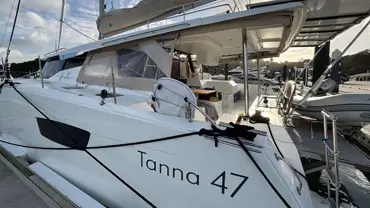
We delivered this brand new yacht from La Rochelle 11,500nm to Tahiti.
Delivering a new Fountaine Pajot Tanna from La Rochelle to Tahiti involved just under 11,500 nautical miles of offshore sailing, multiple climate zones, and a delivery schedule that required balancing passage speed with commissioning realities on a brand-new production catamaran.
Long-distance deliveries on newly launched multihulls are very different from moving older owner-equipped cruising boats. The vessel is typically still settling into operational use, systems are being properly exercised for the first time offshore, and there is usually a significant amount of setup work before departure even begins. In this case, the yacht left France effectively straight into an ocean-crossing delivery profile rather than spending months in local coastal use beforehand.
The route out of La Rochelle required careful seasonal timing through Biscay before working south toward the Canary Islands and then across the Atlantic. On a vessel like the Tanna, which is designed primarily as a modern cruising catamaran with significant accommodation volume, loading and trim become more important once provisioning, spare parts, safety gear, and offshore fuel margins are added for a delivery of this scale.
Preparing a New Production Catamaran for Offshore Work
One of the realities with factory-fresh catamarans is that offshore preparation often extends well beyond a standard commissioning checklist. Systems may technically function at the dock while still requiring adjustment once subjected to continuous offshore use.
Before departure we spent considerable time going through:
- rig inspection and tuning
- sail handling systems
- steering and autopilot calibration
- chafe protection
- spare parts inventory
- watermaker operation
- charging systems under sustained load
- storage and securing of equipment offshore
On a modern catamaran like the Fountaine Pajot Tanna, electrical load management matters more than many owners initially expect. Refrigeration, watermakers, navigation electronics, lighting, communications equipment, and autopilot loads are all substantial during long offshore passages. Managing charging cycles efficiently becomes part of the daily routine rather than something occasional.
Atlantic Crossing and Trade Wind Routing
The Atlantic section settled into relatively standard trade wind conditions once south of the Canary Islands. The advantage of a catamaran delivery route like this is that the vessel can maintain consistent daily mileage without pushing hard, provided the weather pattern remains stable.
That said, average speed offshore is only one part of the planning equation. On deliveries of this distance the operational focus is usually preserving equipment, reducing unnecessary wear, and maintaining manageable crew fatigue over several months rather than chasing peak numbers.
The Tanna handled the downwind trade wind conditions well. Like many modern cruising catamarans, it performs efficiently once apparent wind angles are managed properly and sail plans are kept conservative overnight. Deliveries of this length reward mechanical sympathy far more than aggressive sailing.
Fuel planning was another ongoing consideration. Although the yacht is fundamentally designed for sailing efficiency, there are always periods of lighter weather, battery charging requirements, harbour approaches, and schedule considerations that make engine management important over an 11,500nm route.
Pacific Logistics and Offshore Routine
For Pacific yacht deliveries, sourcing parts or arranging repairs mid-passage cannot be assumed. Spares carried from Europe become far more important once moving deeper into the Pacific islands.
Approaching Tahiti after a delivery of this scale is always notable less because of the arrival itself and more because the vessel has effectively transitioned from factory launch status into a genuinely offshore-proven cruising platform by the time it reaches French Polynesia.
Offshore Delivery Considerations for the Fountaine Pajot Tanna
The Fountaine Pajot Tanna is well suited to long-range cruising provided loading, sail management, and systems management are approached realistically. Like most modern production catamarans, they reward conservative offshore operation and good preparation more than aggressive passage making.
For owners relocating new catamarans from Europe into the Pacific, the delivery itself often becomes the vessel’s first true systems test. That makes experienced offshore preparation, routing, and onboard management particularly important on passages of this scale.